Showing posts with label General Fengshui. Show all posts

Sunday, May 25, 2014

Confronting Y Again!


Reflecting one of the article in the now, defunct blog - 13Voices, about Property located on a WaterShed will sure to meet its doom, many of the observations revealed otherwise. It is a FengShui External Taboo no-1 that state, NEVER locate your property in a watershed. For us in QuanYuan, there is a way to go about it - fortunately. 

A “Y” configuration is either a road splits into two or both roads connect into one. The former is known to be a water mouth and the latter is known as the watershed. Our article entitled "Confronting Y" is a good reflection of such that it is never Bad FengShui if a property is located in a watershed subject that you know how to position your entrance. The HongKong master always refer to such as "Confronting SanSha".


A case in reference, Shop-A is located in a location that fulfilled its YinYang structure. Used to be a good F&B shop and it was audited by a YangGong master. Few years down the road, it ceased to operate due to high rental.

Shop-B is located in a location of the so called watershed. Many operators failed that include F&B operators. The last tenant rope in another not very well known master. The rest is history. It prosper liked nobody business. You practically have to queue up to get a seat.

The morale of the story, watershed FengShui is salvageable and if you know what to do it brings you windfall.


Tuesday, August 6, 2013

LianShan GuiChang 连山归藏 and MingShi PanXian 明師盤線


Back in Sept 2012, I have written extensively on the Trilogy of The SanHe Lord of The Rings: Fellowship of The 24 Mountains, The Two Mountains and Return of The Seam Needle. It is interesting to note that Skinner mentioned about the “Outer Heaven Plate” being the Seam Needle in his LuoPan Compendium. The “Outer Heaven Plate” consists of the followings: - 

1. The 28 Asterisms. 
2. The 365 Degree of the Asterisms. 
3. Annotation to the Degree of the Asterisms. 
4. 60+ Contracting and Expanding Dragons. 

These are grouped as “outer” because it comes after the YangGong’s Heaven Ring. In some Chinese LuoPan, this “outer heaven” plate is given some special rendition such as XieZi, LianShan GuiChang 连山归藏 60 Dragon, MingShi PanXian 明師盤 Gold Division and so forth.  

Very little is written about this in the English literature. Google LianShan GuiChang 连山归藏 and MingShi PanXian 明師盤線, 2 thick Chinese books written respectively by Chen YiCheng 陳怡誠 revealed. These books appeared to be laden with formulas and charts describing the application of LianShan GuiChang 连山归藏 and MingShi PanXian 明師盤線. However, the actual contents related to LianShan GuiChang 连山归藏 and MingShi PanXian 明師盤線 is very minimal and ambiguous in nature. It generally specifies the usage of the “outer heaven plate”. 

In relation to LianShan GuiChang 连山归藏, the salient features are: - 

1. Verifying the spot based on Degree of the Asterisms. 
2. Degree of the Asterisms as the Host, 28 Asterisms elements is the Guest. 
3. 5 elemental interplay justify the Degree to be usable or unusable. 
4. Based on this spot sitting, deduced the DaGua elements using the 60+ Contracting and Expanding Dragons. 
5. Some permutation using NaJia is required. 
6. Similarly, water locations at the embrace must conform to 5 elemental interplay. 
7. This is also known as Six Relationship六親/ LianShan GuiChang 连山归藏 water method 水法. 

In relation to MingShi PanXian 明師盤線, the salient features are: - 

1. As the 1st book did not specify incoming or outgoing water in the Six Relationship 六親/ LianShan GuiChang 连山归藏 water method水法, MingShi PanXian 明師盤線 attempt to justify incoming or outgoing water positions. 
2. The justification uses YangGong 12 growth phases. 

The drawbacks are: - 

1. It never specifies which sets of 28 Asterism to use, knowing well that the 28 Asterism has since shifted? 
2. It did not clarify the origin of the LianShan GuiChang 连山归藏 elements attached to the 60+ Contracting and Expanding Dragons. 
3. Constructing the DaGua Hexagram and assigning its elements are hilarious. 
4. Ultimately, it has to succumb to use YangGong 12 growth phases to justify water exits.

If you have paid heftily for those courses that were taught based on the methods of these books, GOOD LUCK!

Thursday, May 16, 2013

The YiJing of Bolehland Government

 
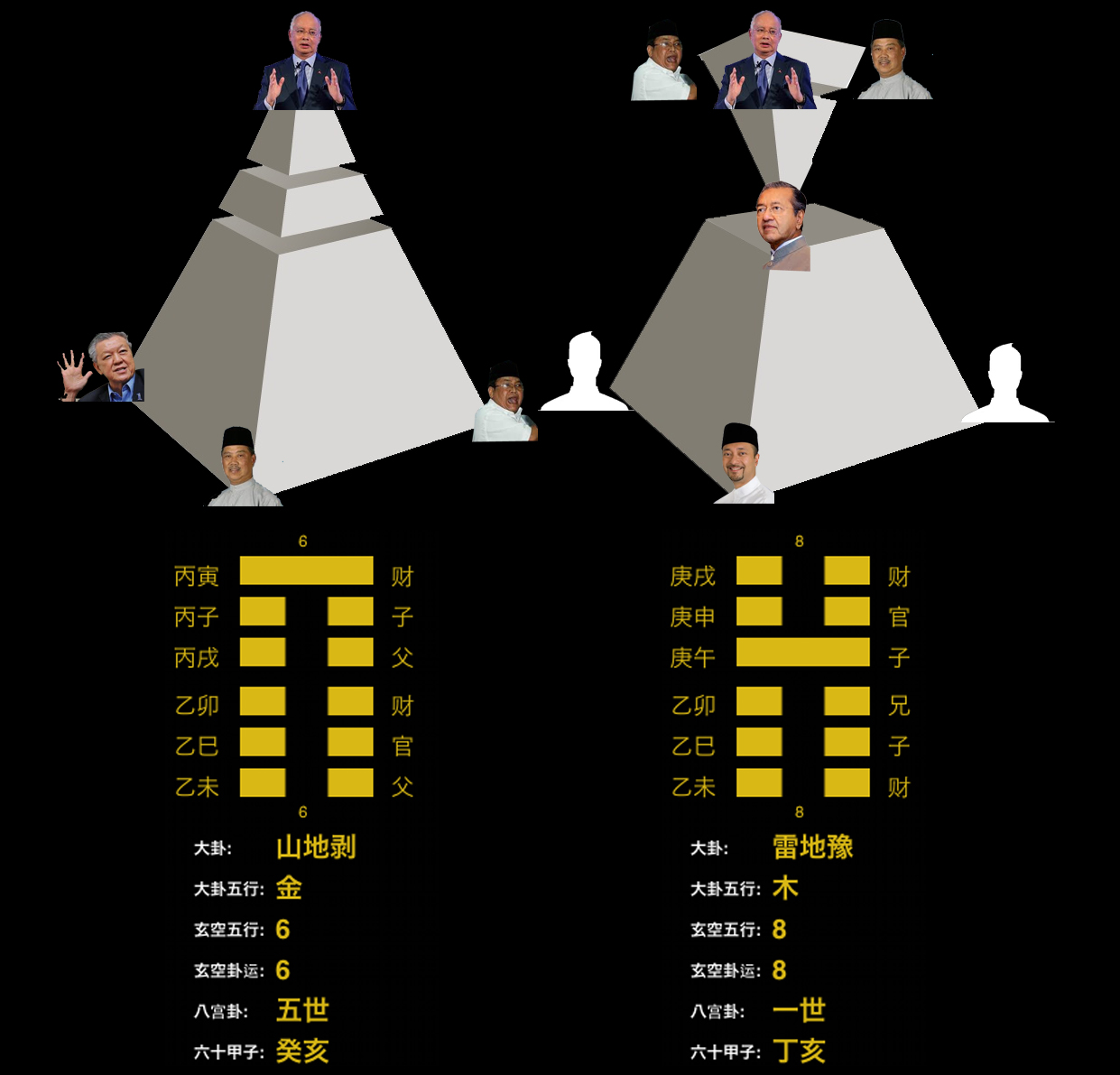
What we perceived Bolehland Executive Structure is liked a Pyramid where its CEO is at the pinnacle. This is a Normal Western Outlook. In terms of YiJing Gua, such arrangement is horrible. Even when he wins the Bolehland election with the slimmer majority, its CEO is on the way to the chopping board and the next CEO goes up the pedestal.
 
However, the Bolehland Supremo is smarter, probably he understood YiJing Gua. He has his proxy runs Bolehland. Anyone failed his expectation; he has someone else ready to take over, ultimately from his pool of family members. A Dynasty in creation. He is the actual seat of POWER. Better, most proxies cannot see eye to eye with each other thus create the “check and balance”. What has this got to do with YiJing Gua?
 
The first scenario is where Gen above Kun. A single Yang Yao supported by all the Yin Yao. Any mistake from the bottom Yao, the entire structure collapse like a house of cards. Do you think it is favorable?
 
The second scenario is where Zhen above Kun. A single Yang Yao just manage to resemble upon crossing the lower trigram. It is liked an impossible task managed to be completed successfully. A break through. YiJing jargon denotes – a successful crossing. So, whichever the top Yin Yao collapse, the Yang Yao is still hidden, untouchable. Beautiful and a good resemblance of DunJia 遁甲.
 
Can never have enough of such ancient timeless wisdom.

Friday, December 7, 2012

Eight Mansions In Application


Eight mansions were also known as YiGua FengShui because it uses extensively predetermination of auspiciousness and ill fates based on the BaGua more specifically, the GuaQi. GuaQi may sounds like rocket sciences but truly a simple logic of permutation between early heaven BaGua with the numerology of LoShu. Such basis are shared between other system of FengShui, notably XuanKong DaGua.

Unlike their counterpart which is the famous XuanKong FlyingStar (XKFX)  which is about 100 years old, XKFX is predominantly based on later heaven BaGua intertwined with LoShu. So technically both of these systems do not come together. They cannot gel because both fundamentals are different. Any force fitting will only make them, nice on theory awkward in application.  So, it is not very surprising to hear that there are new theories such as YiJing FlyingStar, YiJing BaGua, QiMen FlyingStar to reinvent the wheel which is deemed unnecessary. The closest attempt is the use of XuanKong LiuFa but it has again fails to determine, could the arrow of time flies backward? On this account, there is no way a frail attempt to say, XKDG is the principle and XKFX is the application, could be justified because, these systems had different fundamentals, to begin with.

Eight mansions had earned its status of notoriety for being simple in application, complicated in justification. Could easily be written off as bullshit FengShui method but until now, no authentic masters are able to do so. There was also claim that EightMansions was invented to con the barbaric neighbors during Tang Dynasty. It was at one time called 'kindergarten' FengShui method but it is utter shameful that such kindergarten status was a foundation for more complicated system liked XKDG to rest on. So by implication, if one fails to apply EightMansion, one also know nuts about XKDG. That is an irony.

There are basically 2 methods of Eight Mansions that are widely known. One uses the Life Gua as the basis while the other, the House Gua. A Life Gua is determined from the year of birth of a person, more accurately its age. Whereas a House Gua is based on the sitting Gua of a house. There are basically two halves, one called west group while the other east group, for ease of discussion.

One attempt is to match the house Gua with its residents's Life Gua. It sounds perfect that a west group life should reside in a west group house. But how often could we get husband and wives are of the same Gua? Being the breadwinner, the husband Gua will take precedent over his wife. As a result the incompatibility of the wife's Gua will result in domestic nightmares. So, it cannot be right!

True enough, it is because of our lack of understanding. Trying to 'fix' it using early and later heaven trigrams association will only make matter worst. The older masters of the FuJian lineage stressed that the correct answers rest in the understanding of the trigram Qian and Kun. Knowing such, Life Gua matching of house Gua is no longer an issue. Similarly husband and wife of different Gua sharing the same bed is also not an issue. That is a reason why a throughout understanding of YiJing is essential.

Infact, the true corpus of Eight Mansions are complete in its original forms with its YinYang and the sort. It also has its own time factor, meaning every building has its life span. Every building's luck undergoes it designated up and down just liked one's BaZi. It has its own method of date selection unlike what is commonly known of the 3 combinations as BaZhai MingJing. The true 'KungFu' is how would one maintain the auspicious luck cycle of the building before it goes downward. Definitely, it does not succumb to taking TangLang as wood Qi.

When opportunity arise, we shall discuss why a formidable SaYuan system liked 8 mansions does not concern how Qi flows.

Sunday, September 9, 2012

FengShui Basics - YinYang of the SanYuan 24 Mountains 2


.. Continue from HERE,

Apparently the compendium of LuoPan is incomplete without the explanation as to where does the YinYang of the 24 mountains of the SanYuan LuoPan originated. We take for granted that it is always there in that fashion. How the PurpleWhite stars fly are all depends on its YinYang. That is already inaccurate. The Chinese source has more details.

One common source is from the Shen's Classic stipulates that all the Yang stems are Heaven numbers for example, HeTu heavenly number 1 takes Ren water Qi and therefore Yang in nature. Earthly 6 takes Gui water Qi and therefore Yin by nature. By the same token, Yin stems are Earth numbers and assigned Yin nature.

Therefore, Jia Bing Geng Xin are all Heavenly Numbers Odd Yang in nature.
Yi Ding Xin Gui are all Earthly Numbers Even Yin in nature.

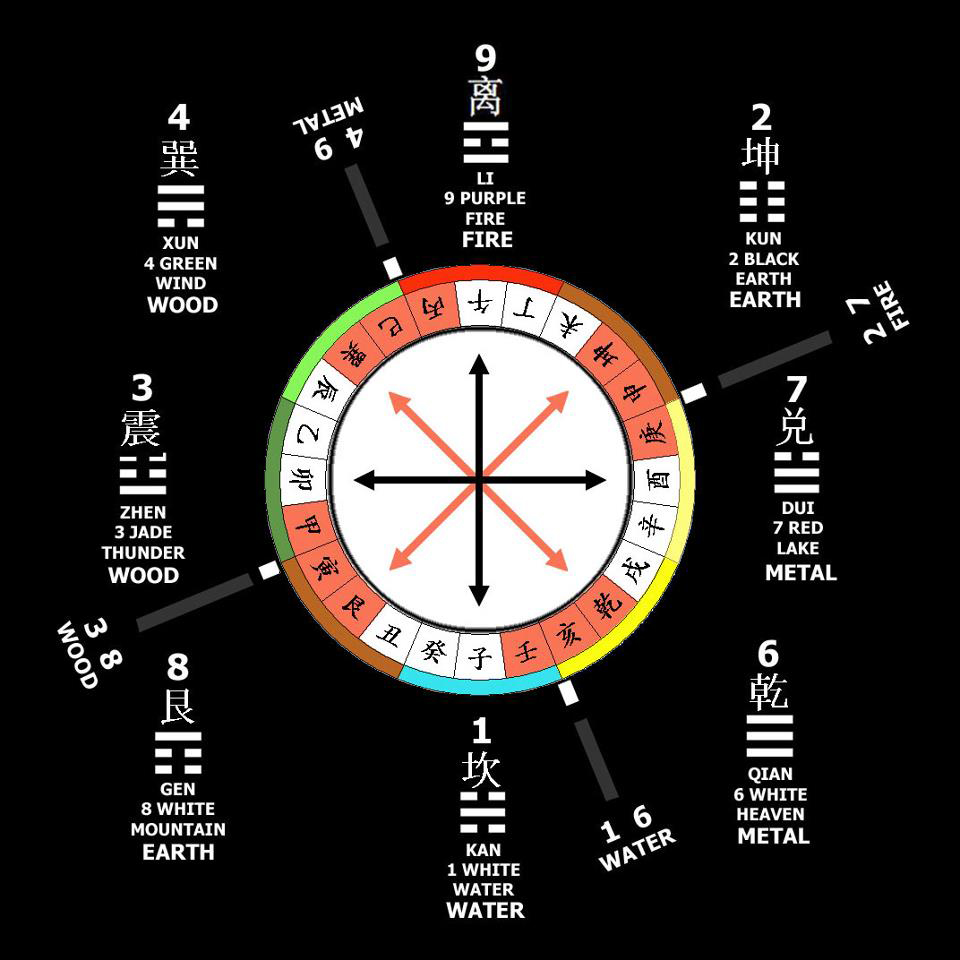
The same classic stipulates that all the Ordinal Trigrams namely Xun, Qian, Kun and Gen are all Yang in nature. The principle is annexed to the LoShu. Within the LoShu, there are HeTu. The ordinals take the following sequence:

Qian (6) and 1-6 HeTu water, 1+6=7, Odd number Yang nature.
Xun (4) and 9-4 HeTu metal, 9+4=13, Odd number Yang nature.
Kun (2) and 7-2 HeTu fire, 7+2=9, Odd number Yang nature.
Gen (8) and 3-8 HeTu wood, 3+8=11, Odd number Yang nature.

The branches are classify under the following groups:

The stable, Yin Si Shen Hai are the 4 beginning of every season. Their main Qi are respectively, Jia Bing Geng and Ren, the sub Qi are respectively Bing Geng Ren Jia with Wu in all the stables. These are all Yang stems. When each of the main Qi and sub Qi added up for each stables, it does not form combination of 10. Therefore they are Yang in nature.

The cardinals, Mao Wu You Zi are the middle of every season. Their main Qi are Yi Ding Xin and Gui respectively. All Yin stems. They forms combination of 10. Therefore they are Yin in nature.

The graveyards, Chen Wei Xu Chou are the end of every season. Their main Qi are either Wu or Ji earth. However their sub Qi are all Yin stems and therefore by virtue the graveyards are Yin in nature for its sub Qi are combination of 10 respectively.

Such is believed to have been the reasons behind the YinYang classification for the 24 mountain in the SanYuan Luopan. in reality, if you believe this is the true reason, your SanYuan applications are incomplete.

Fact, YinYang does not stem from pure numerical permutations. They are the reflections of Heaven Man and Earth. Knowing thus you will understand what a SanYuan LuoPan is designed to measure. Without a throughout understanding of such, all the other Hexagram plates are nothing more then pure decorations.

P/S: Image credit to BengKung Tan

Thursday, May 31, 2012

Good FengShui Advice - A Must Read for Landform

I am extremely lucky to have come to know about a book, written for "kindergarten" practitioners in mind in very simple English minus difficult FengShui jargons and big ideas which are good in theory but lousy in application. Most FengShui literature in the English language is either to:- 

1. Self glorification and self promotion. 
2. Says very little or enough to create curiosity to entice readers to enroll into their live courses.
3. Commentary on the classics based on one assumed opinion. 
4. Compilation of piecemeal theories in meaningless diagram and charts. 
5. Technical manuals like compendium with minimum or no explanation. 
6. Verbatim translation which offer no explanation whatsoever. 
7. Poor scholarship of classical commentary based on defensive writings. 
The list can go on and on... 

But this very book is different! It has an unattractive title such as Good FengShui Tips that if you Google, you will get loads of result on it which tells you what to put in your TaiSui area or your bedroom must go along with a pair of mandarin ducks. That is exactly what the book is intended for - Non pretentious and to my surprise, minus the mandarin ducks and whatsoever placebo FengShui. It is an honest interpretation and not just translation of one of the maverick illusive FengShui grandmaster of all time - Jiang DaHong. 

A beginner will read it just like any "cook book". They will usually miss the salient points. Those who are in the know how will take its content as a wakeup call. Almost each sentence is woven with FengShui secret methods or gold nuggets much more expansive then the overpriced live modules for a cost below USD10.00. Yes, you get a shock! 

If one ever asked, what book shall I read as a start in Landform FengShui, this is one book you cannot NOT read. It is a turning point to be a genuine practitioner. The only problem is, you really need a genuine master to point to you what are the hidden nuggets concealed within the book's simple English designed for easy reading. 

The author has demonstrated his knowledge without the need to belittle others, shared his wisdom in genuine gesture without pretends in prudence manner and subliminally informing everyone that you don't need to be a superstar to proof your skill as a knowledgeable practitioner. 

Let me indulge to quote: 

“Why take the door? The door is the SPOT where the Qi is activated and spread out to the interior space… By knowing this Qi distribution, we are then armed with the necessary information to best work with the Qi that is present within the internal and external space…” 

This very sentence says about: - 

1. The Door Xue is the point of reference to plot your internal Qi map 
2. Having this Qi map, one will know how Qi is drawn from the external 
3. And distributed throughout the internal space 
4. Then, one is able to design one’s table, bed or stove to receive Qi 

So you know why your 8 Mansions sometime work, sometime don’t? I am dearly looking forward to his next publication.

Monday, May 21, 2012

发微论 Fa WeiLun of A Mall


Reading landform classics is not that easy. The classic, 发微论 by Cai YuanDing, 蔡元定, is not an easy script to digest. The YangGong old school did not look highly upon Cai YuanDing, 蔡元定, as a genuine FengShui master. 

They claimed that, “…“Fa WeiLun (发微论)” by Cai YuanDing, together with “ZhaiJin” by Yellow Emperor are not FengShui classics, so due to… misinterpreted The Burial Classics by GuoPu, who is the ancestor of FengShui studies, thus it lead to misunderstanding…” 

However, 发微论 talks about balancing YinYang, which is the first layer of landform consideration that many overlooked. Balancing YinYang may appear to be simple but within Yin there is Yang and vice-versa, complicates matter. So undoubtedly, 入地眼 or Entering Earth Eye, is still the preferred choice for the mechanics of landform. 


The art of effective FengShui is simple in its purest form. If properly apply, even using Zhen WuXing or direct 5 elements, one is able to see result. There is always something common among all the successful outlets. It is the role of the practitioner to distill its truth, even if it means reverse-engineering. That is the learning path to understand FengShui minus all the theories which sounded good in paper but awkward in applications.


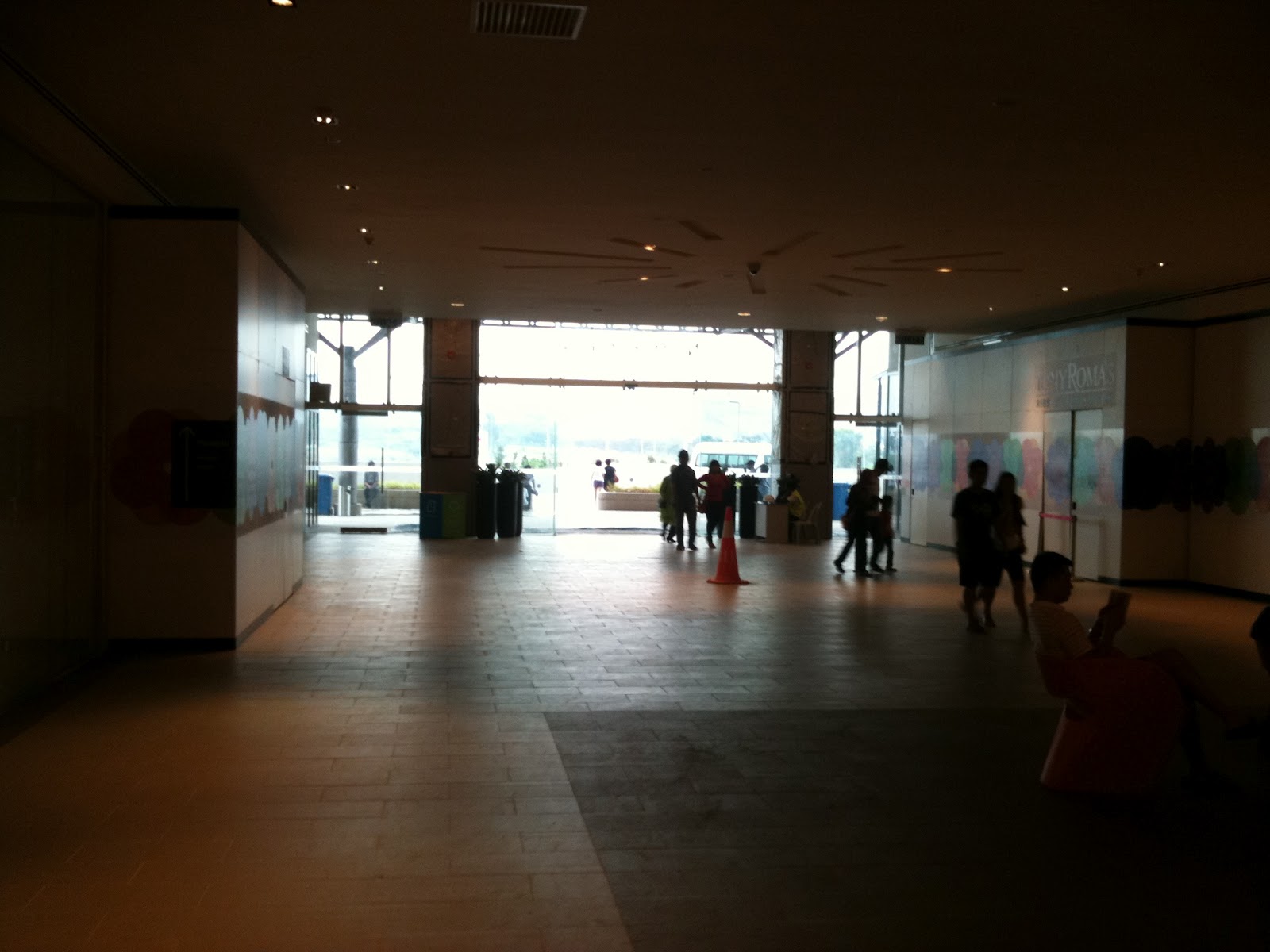
The recently opened mall in the suburb was flooded with people. It was designed with FengShui in mind and the master who does that was apparently a SanYuan expert. Water is used extensively on the external unlike the Sand Mall in Singapore, drawing Qi into its main entrance. Balancing YinYang is apparent throughout its Qi distribution techniques making every outlet a fair share to receive Qi. Yet, there is no black turtle and white tiger presence. A worthy mall to examine, FengShui wise and not forgetting, it has no Tilted Doors!

Monday, April 16, 2012

Crab Penang FengShui 101


Very strange, all the sudden, Penang is in the spotlight comes RenChen, especially so when FengShui and BaZi workshops are of the concerned! We had been traveling often to this pearl of the orient. Just minutes before the recent tsunami warning and a quake nearby the Indonesian Island, we were in the airport boarding home. Lucky us! On air one will be amazed by its mountain formations. Especially so, when the “sedan chair” formation is often misconstrued as the most auspicious formation where a so called dragon spot will emerged. This is a greatest misconception. 

A Sedan Chair formation or sometimes analogized as a Crab formation is when a dragon spot is surrounded by the parent mountain, embraces and a table mountain. However, it is not a “Crab” that forms the spot. It is the “scorpion” that does the work. As such, the crab is a crap. Why is it a scorpion instead of a crab? That is a million dollar question, some kinkily called it XieZi. 

Not all such formation produces quality dragon spot. In fact the tell tale sign is within its vicinity. One logical expression is how can there be a quality spot when its surrounding is dilapidated low cost shanty buildings? Look at Georgetown Penang for example; the prosperous city is located between the river and nothing close to the so called dragon spot. If commerce is of the concerned, would a dragon spot make of any use? 


Based on the sedan chair formation existing in Georgetown, it is believed that the dragon spot is located somewhere in the Air Itam region now occupied by the Kek LokSi temple. It is one of the largest temples in town with plenty of funds and willed political influences. Does this very temple prosper because of the sedan chair formations or something else? A close up via GoogleMaps did not even revealed that it is sited at a so called niche of a dragon spot or a valley! So, technically the spot is fictitious.

There is a reason why our old master always led us walking the mountain from the lowest point onwards through the embrace up the parent mountain before descending to a plateau to see sunshine penetrating clouds over the valley. There is a reason. It is really not because of the crab but the scorpion.


Other sedan chair formations of lesser qualities are found within Tanjung Bungah and Batu Feringgi. Yet there are also even lesser qualities straddle around Teluk Bahang and the sort. What makes these locations different compared to Georgetown?

In summary, you don’t need a spot to prosper!

Saturday, April 7, 2012

The Chinese Calendar 4 – Knowing the Year, Seasons and Days


A Tropical Year is calculated on the basis of the Earth moving around the Sun. The equinoxes and the solstices demarcating Earth’s distance, nearest or furthest away from the Sun marking the 4 seasons where the extreme Yin begins in Zi and the extreme Yang begins in Wu month. 

Of the 4 seasons, the 24 seasonal nodes are referred to as solar markers. One season governs 6 seasonal nodes. Therefore, each portion governs 3 seasonal nodes, thus vernal equinox in spring becomes an important marker where wood Qi is at its optimum. 

The Stables Qi is at its infancy (growth), the Cardinals Qi is at its peak (prosperous) and the Graves Qi is at its tomb (storage). These are the basis of SanHe’s 12 growth phases, measuring the “HouQi” or vital Qi which implies that influence between 2 gravitational forces at its strongest and weakest. It takes 15 days for a revolution of HouQi. Multiply by 24 seasonal nodes, a year contains 360 days.

But our Modern Day calculation state that it takes about 365 1/4 days for a year. Would such make the Calendar obsolete?

Thursday, March 22, 2012

The Secret Art of Placebo FengShui

FengShui has nothing to do with the art of placement be it symbolically or otherwise. The matter that is closest to such as in accordance to the Classics are building mountain and pagodas. It just to tell you miniaturized pagoda, Qilin, FuDog, PiYao, a pair of mandarin ducks and the such are just home decor or otherwise "wishful" thinking. There is also NO such a thing as secret formula of the art of placement. Ancient's emperors built pagodas and mountains to manipulate environmental Qi and what would a pair of little mandarin ducks draw, spice? 

Again, if ever using symbolism with the trinity usage of door, bed and stove for internal FengShui  warrant effectiveness, better think twice again! Why of all built structures, the door, bed and the stove only? There are more things that a competent practitioner could do. If one understood the importance of balancing YinYang, everything will fall in place, just liked what the classics said, "Not knowing the approaching road, the 8 trigrams are all empty". 


Thursday, March 1, 2012

Good FengShui Shop


One of the light fittings supplier in town. This outlet is so dated compared to the other posh outlets and yet the business is the best in town. Capable of buying over a notable HongKong brand and now it’s sole distributor. FengShui wise - impressive. 


Receiving Yin formation and yes, yes, yes… NO DOOR whatsoever. How to tilt and do the boogey woogey? One more thing, there is apparently a water dragon in the form of the water “lizard” and yet it is NOT CUTTING FEET.

This is another classic example of the art of receiving Yin and pushing Sha, 收山出煞 used at its most elegant way. One do not even notices that it has been FengShui-ed. Apparently the text book descriptions are found such as the 4 “guardians”. The YinYang is well balanced and the main door is  receiving Qi. Three separations and three combinations of the bright hall are obvious.

No wonder it prosper! Reliable source revealed that it is done by a SanYuan master.

Sunday, November 20, 2011

FengShui Basic - 8 Aspirations

In the discourse of Internal FengShui, you will term with 8 aspirations school: there will be sector for academic, wealth, health, romance and so forth. The 8 aspirations school is a modified method. If there is a basis for Life Palace analysis in XuanKong, there must also be the basis of Wealth, Health, Academic, Romance and so forth. These are the specific purpose. The problem is we seldom ask beyond what has been given. 

While we spoke about specific purpose, the 8 aspirations are the common needs within a household. The question is, have we not achieved the aspirations after investing our hard earned money into learning FengShui? Is it the theory we learnt is faulty or the teacher simply doesn’t bother to teach the correct applications? Such, I leave it for you to contemplate.

Aspiration is personal. Unfortunately, in modern times, money is the yardstick. Predecessors liked Yang - the Savior of the Poor to Lai - the Wanderers in Cotton Robe, live in low profiles and avoid glamor. Maverick Jiang – the Keeper of Heavenly Secrets has to have his disciple sponsor his retirement home. By the same token, if honest masters were to walk their forefather’s path, wouldn’t they too end up in such a situation? Contrary, the “CON-sultants” who will live a posh life from Giorgio to Armani, while promoting FengShui as expansive hobbies.

We came across a place dedicated to a FengShui "extremely low profile" grandmaster of the past. He conceals himself as a beggar and helps the poor to have better lives based on the principles of affinity. One question remains, why wouldn’t he use his knowledge to make himself fabulous? Would a rich client come to him for FengShui advice? Such, I also leave it for you to contemplate.

Look around us today. If one takes FengShui as a career, the good one will end up liked their forefathers - childless, die-young or ultimately, live a pauper. If one takes FengShui to prosper oneself then to help others to achieve the same, it is no longer a career but a charity. Charity must always stem from education. So, why shy away from teaching others the correct path and learn from our past mistakes? 

In doubt, affinity is always the guiding principles – that is what QuanYuan is all about.

Tuesday, November 8, 2011

FengShui Basic - To Move or Not Move


Movement and Stillness, these are the two words that are simple yet complicated. 

"It begins with movement; hardly can see a thing, when it comes to stillness, all begin to understand. When one sees stillness as the essential marvel, how may one knows that movement is the foundation?"

A competent practitioner would utilize an unfavorable sector to his advantages. A competent BaZi consultant would also use the negative gods. Beginners’ mistake is to equate the use of Eight Mansions with Flying Stars. These are two methods with different fundamentals. Eight Mansions stem from Early Heaven while Flying Stars stem from Later Heaven. Not surprising if someone were to asked, “What if the sector has a JueMing but yet a favorable 8 wealth star?”

Eight Mansions talked about Gua Qi, elemental relationship. Flying Stars talked about GuaXiang, imagery. The Classics state, “The Gua imagery is established on the basis of their meanings; understand the images and forget the words – the idea is clear of itself. The whole world delusively clings to the imagery; uses GuaQi and rise in levitation.” The elusive meaning of GuaQi remains the key, which many teachers refused to depart.

Evaluating internal spaces, GuaQi remains an important factor. What would be the reference for the interior? Such is called the YinYang boundary. It is the point to distribute the stars. The strangest thing is why must the reference be located at the center? Why must the Wedge be placed at the center? Why must one even smack the 9 Grids forcefully into the house plan as though there is a physical boundary between Qi? What if the physical demarcation of architectural walls differs from the 9 Grids? Why must there be even Grid Vs Wedge? Such reflects the lack of understanding in FengShui fundamentals.

The grid and wedge are simultaneously deployed. The wedge referred to the art of LiPan, establishing the LuoPan. The Grid is an aid of accessing Qi maps. While drawing up Qi maps and establishing the LuoPan became the integral part of a competent practitioner, many were not taught the proper way of doing such. To convince one that Qi moves as LoShu would not guarantee one’s application of eight mansions or FlyingStar is correct. The key is not with LoShu, but to understand how Qi spirals in 3 dimensions and work thereof. Such will work perfectly with whatever given architectural plans.

Only then, would the knowledge of stillness and movement work within the misconstrued Direct/Indirect Spirits, another malicious subject. In summary, Internal FengShui is all about the art of identifying internal Qi maps, activating, receiving or transforming  through the various essentials of a Yang Dwelling.
Saying thus, the success rate is still within its external!

Friday, November 4, 2011

FengShui Basic - Learning To Unlearn


When comes to learning FengShui, one of the most regrettable aspect is to hastily put to test what one has learned and easily discard it when good results are not seen. Sometimes it is always the hype that what is learnt is always better then what has already known. Doubt is always the best teacher as it is the devil and angel in the same package. For instances, internal Qi manipulations will not work if one does not know how to receive or acquire Qi from the greater external. That is why FlyingStar, 8 Mansions and the sorts are just as good theory on paper. A Qi container (house) will always remain empty unless one put something into it. It reminds me of the following sayings: -

“Swallowing saliva and acquiring breath are human actions; only when one knows the Way, one is able to form and transform, just liked in a Ding (tripod) there is no True Seed, liken to use water and fire to boil an empty pot”

So, when one fails to see result, we blame the method that was taught was incorrect and we fails to see that it is the reluctant of the teacher to pass on the “key”, for whatever reasons. It is only upon seeing and watching carefully of how a teacher executes his work in real life audit, would then one able to know the conditions for a method to work. Such will traditionally comes with a bucket load of insults and intimidations from being a coolie to someone holding the teacher’s bag and umbrella. In the modern context, it will be par on material gains which is nothing to be surprised of.

The complexities of residential FengShui is such that if nothing could be done to the Main Door and the Bedroom or even the Kitchen Stove such as a portable stove over a fixed stove so as to get a “perfect” XKDG hexagram, what else could be done? One friend from France suggested that to take a hammer to activate all the good SanSha points and at the same time digging all the relevant parts in the yard to challenge the 5 yellow. Such is not always the way. 

Another case in example, a gentleman passed his prime and ended up retrenched with a family to feed. What would be the specific purpose in this case? Food on the table is the priority. Does one go about tilting doors, tables, stoves and maybe beds? This family has not enough money to do the necessary and one strange thing was even the bed was built-into the wall. A simple intervention of changing the joss urn made it possible for the gentlemen age 50 to be employed. Can such be considered simple achievement for a specific purpose? 

A competent practitioner never stop learning and practicing. By practicing on the fields he learns something new and unlearns something old. Every case has its own set of challenges and limitations, if it is not carefully dealt with, it may haunt you forever. Yet, when you know that the FengShui methods you used, improve the lives of the many such as healing the sick, putting enough food on the dining table, getting childless couple to finally have children and helping your peers and students to have a decent promotions, the satisfactoriness of such meritorious deeds are far better than creating the number of millionaires. 

Perhaps, such wisdom  may appease our doubtful minds: -

"It begins with movement; hardly can see a thing, when it comes to stillness, all begin to understand. When one sees stillness as the essential marvel, how may one knows that movement is the foundation?"

Thursday, November 3, 2011

FengShui Basic - Specific Purpose In Generic


It is very common for householders to suggest generic needs such as the well-being of the family while residing in the house. I would say it is generally accepted norms to prioritize well-being as the first criteria in residential FengShui. However, the notion of well-being is far too generic and it became the burden to the practitioner of not defining such in the onset of their audits. So, as a prudent measure, seasoned practitioners would qualify further assuming: -

1. Family Harmony ranks priority
2. Health Improvement for the Elderly
3. Wealth opportunity for the Bread Winner
4. Academic achievement for the school going children

These became the so called “specific purpose” which may have been silent in the pretext of “good health and good wealth” generic needs. Saying thus nothing is deemed to have been cast in stone, as this is a living art, best demonstrated by the following example.

We audited a small family where the gentleman is living with his mum while his dad had passed away. So, we only have 2 variables to deal with, one, the bread earner and two, the elderly mother. The gentleman is single and working in a multinational company. Needless to say, opportunity for promotions and meeting the opposite sexes would automatically be the priority while for his mum, health improvement ranks supreme. At this juncture, we are able to narrow down to a specific purpose and with very simple alteration using the so called “kindergarten” 8 mansions, he was promoted. We also observed there is a better change in his attitude towards other which results in him attracting the opposite sexes. His mother, on the other hand, has less sleepless night and less worry. We could not believe such a simple method would bring about good results and more importantly his dad has a permanent place within his blessed home. When identifying water mouth became difficult, use Heaven Qi approach, as this art is a living art.

Residential FengShui is more challenging in that forms as compared to Commercial FengShui, where the bottom line is profitability. As we grew wiser in our practices, we noticed that a good practitioner is able to intervene in any given situation. He does not run away when situation does not present upon him an ideal situation such as what if the Killing Forces in the area is overly strong? Move away? What if he cannot afford to do so? What will be the better alternatives? Drop the case and ask him to look for other practitioners instead? 

Any competent practitioners would have made mistake. More importantly, he must be humble enough to learn from it. The Chinese Ideal of first Destiny, second Luck, third FengShui, fourth Meritorious Deed and fifth Education had been greatly misunderstood. For example, Education is a reserved privilege for the male gender in the aristocratic Chinese community. Does it means to say, female is devoid a chance to improve on their Destinies, for not being given the opportunity for education? No, education in the simple Chinese nuance means learning from one’s mistake and takes step to improve oneself. This is the very basis of doing meritorious deed to oneself and others will naturally comes its way. 

“The cosmos lies in one’s hand, the ten thousand transformations are born from oneself.”

Thursday, September 29, 2011

FengShui Basic - YinYang of The SanYuan 24 Mountains


… After all the heavy weights, let us come back to FengShui 101.

There are a few good books in English explaining about LuoPan, including the Compendium. However, it never dwell deep into the origin of YinYang of the 24 mountain plate of the so called, SanYuan LuoPan. It only prescribed that 24 mountain is further categorized into Heaven, Man and Earth subsector or Yuan Dragon in the manner of Yin-Yang-Yang or Yang-Yin-Yin configurations. Thereafter… nothing mentioned.

To the ONE RING masters, especially from the Flying Star School, these Yin-Yang-Yang or Yang-Yang-Yin configurations are how the 9 stars “fly” forward or backward in the LoShu chart. Beyond that… nothing mentioned.

So, before one worries about 明师盘线, loosely translated as Great Master’s LuoPan Line, emmm… what say if one try to find out, why do of the so called, SanYuan LuoPan has the YinYang configuration such as this?

Sunday, September 25, 2011

FengShui Basic - Entering Earth Eye (入地眼)


Almost fainted! One chap from Penang emailed and give an outright pop-quiz, asking – where is the moosti-spot? The picture has been reproduce in graphical manner, to illustrate the virtual veins from the series of humps some called Dragon. Honestly, such pop-quiz like this nature really belittle the intelligent of the author of RuDi Yan 入地眼 or Entering Earth Eye, believed to have been written by GuTuo of the Zhou Dynasty. By the way, why all the sudden so much interest has been garnered on this single classic? Is it because of QuanYuan's syllabus?

This classics lay out the fundamental of locating LongXue 龙穴, which some believed to have been as small as 3 feet by 3 feet, where the coffin needs to be buried vertically, is uttered rubbish. This is called, Die Standing! Some market it, liked nobody business, other holds it so sacredly that they were given specific instructions as to how many LongXue 龙穴 can they dot in their entire life. It is even coded in their name, for example Mao ZiDong’s FengShui master  不过五, where 5 is the limit.  Anyway, if one really waits for the so called LongXue 龙穴 to be buried 6 feet under, well just wait. There are always better alternative.


Contradict to many believes, most vibrant cities liked Bangkok, Rio and New York are flourishing in coastal, flat and probably what is significantly known as Spiral City or area surrounded by mountains. Take a good look at Rio, for example. The slums are actually dotting the mountains. Wonders why are all those "Dragon Spots" seem to breakdown or probably it will not work in the other side of the Pacific? 

Entering Earth Eye does not warrant one to climb mountain everyday, in this modern context, just to look for spot. Unlike rural area, urban context is a different cup of tea. GPS and GOOGLE are new technologies that ease determination of a FengShui structure much-much easier compared to our forefather's era.

Furthermore, this very town would not have flourished if the LongXue 龙穴 is only nestled around the “moosti” spot? So, it cannot be just a spot right? If one understand the essence of RuDi Yan 入地眼, you are able to make do with receiving ShengQi everywhere. You do not need a 3 feet by 3 feet spot to Die Standing.

Wise up!

Wednesday, March 2, 2011

Something About White Tiger 白虎


In landforms, it refers to the mountain at the right side, originates from the astrological four enclosures of the western sector of the sky which form the imagery of a tiger. Under the influence of the west being the sunset location, it bears the color white with the Gua imagery of Dui, it also represents the female gender as a collective notion of White Tiger.

The dictum that the White Tiger must not be higher than the Green Dragon is very common but unfortunately, it does not necessary bear the truth and the topography of China is the best testimonial of such. If the right embrace is higher than the left embrace, it is called White Tiger jumps over the wall, signaling the rebellion of the female householder.


Another dictum is that the White Tiger opens its mouth (白虎开口). Traditionally it refers to the right side of the embrace having caves with cavity revealing the rocks and hard surface, resemblance of the tiger’s tooth which is an indication of killing forces emitting there from. Modern interpretation is when a property is built with a grand front porch having at least two grand columns representing the tiger’s fang it is called White Tiger opens its mouth. 

Comes the season of awakening of hibernated insects (驚蟄), another form of White Tiger opens its mouth is largely related to cultural significant of appeasing the White Tiger. Astrologically, the season of awakening of hibernated insects is more or less 15 days after the last seasons of rains. Such will continue with thunder strikes effecting spawning insects to feed on the crops. This season will be the arriving of Mao month at the Zhen sector based on the 24 mountain plate, denoting thunderous awakening. In mountainous area such thunderous roar with the white mist rolling downhill from the mountain is taken, by the ancient, as white tiger descending from their abode to hunt. Thereupon, it becomes a cultural significant. To appease the White Tiger, the villagers literally bring foods in the forms of egg and raw pork with lark to the nearest mountains and caves known to have been infested with wild animals with the hope that these creatures will be kept at bay. 

Taoist interpretation, White Tiger is personified as a group of deities within the earth bound deities category common to the Earth Deity, Datuk-Kong and so forth. It is believed that these earth bound deities have the influenced over the wild animals liked the tigers to descend from their abode to hunt. Thereupon, a Taoist ceremonial aspect is modeled with hitting the Petty People (打小人) in placed. The logic is when you fed the tiger also request it to bite your petty people away. Such wishful thinking leads to hitting the Petty People in the forms of aggression released exercise by hitting the paper effigy with newly bought slippers, then disposed it off via burning later to be followed by other rituals. 

No matter how one looks at the dictum of white tiger, there are many inconsistencies to the practices. Likewise, some say, White Tiger is offended by people born in the year of Hai, Mao, Wei and Si, while others also quoted, Chou, Zi and Chen to be inclusive. The transition time of awakening of hibernated insects (驚蟄) is 6:29am on March 6th, preferably go to a temple close to a mountain for such an act of devotion. 

My take in lieu of hitting the petty people is simple, just do good, avoid evil and purify one’s thought.

LinkWithin

Related Posts with Thumbnails